



服务热线
15365833739 
As skeletal health gains growing clinical attention worldwide, safe and convenient bone mineral density assessment has become a prevailing demand for clinical screening and rehabilitation follow-up.
Radiation-Free & Non-Invasive, Suitable for Broader Populations
Unlike traditional X-ray bone density testing, quantitative ultrasound (QUS) bone densitometers adopt ultrasonic technology, delivering entirely needle-free examinations with zero ionizing radiation.
This means the device is safe not only for adult patients, but also children, pregnant women, and individuals requiring frequent repeated scans. Its advantages are particularly prominent in general physical examinations and community mass screening programs.
1-Minute Rapid Scan to Boost Clinical Throughput
The scanning workflow is simple and streamlined: clinicians only apply ultrasound couplant to the target site (typically the radius or tibia), place the probe, and the device completes all measurements automatically. Test results are generally generated within one minute.
For medical facilities with high outpatient volumes requiring fast patient turnover, as well as mobility-limited elderly patients and rehabilitation cases, this efficient workflow drastically cuts waiting times.
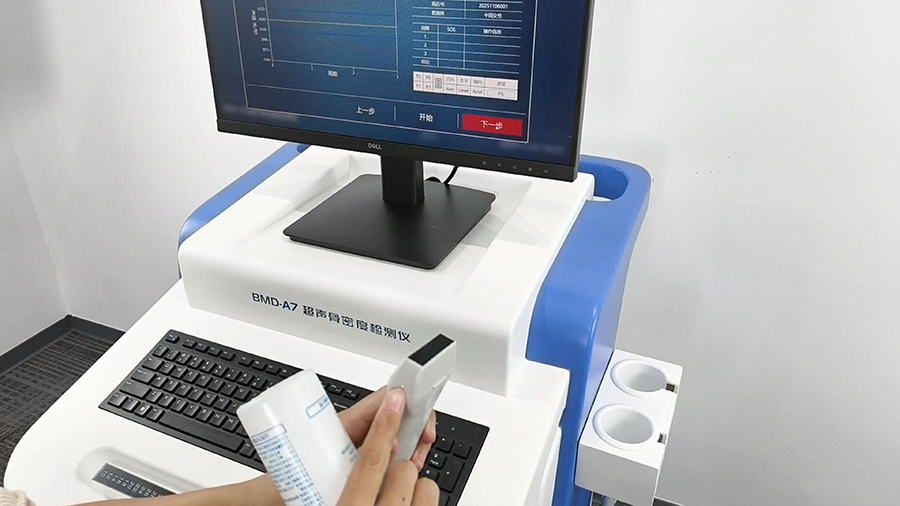
Multi-Scenario Compatibility, Deployable From Hospitals to Primary Care Settings
Available in trolley-mounted and portable configurations, the unit features intuitive operation without the need for dedicated room renovation or radiation shielding facilities.
It can be flexibly deployed across comprehensive hospital departments: physical examination centers, endocrinology, obstetrics & gynecology, rehabilitation; alongside community health service stations, elderly care institutions, sports medicine clinics, and school-wide health screenings. A single procurement enables shared use across multiple departments or separate medical institutions.
Factory Pre-Calibrated, Plug-and-Play Operation
Every unit undergoes full system calibration before leaving the factory. Upon delivery, users skip complex debugging procedures and can start scanning immediately after powering on.
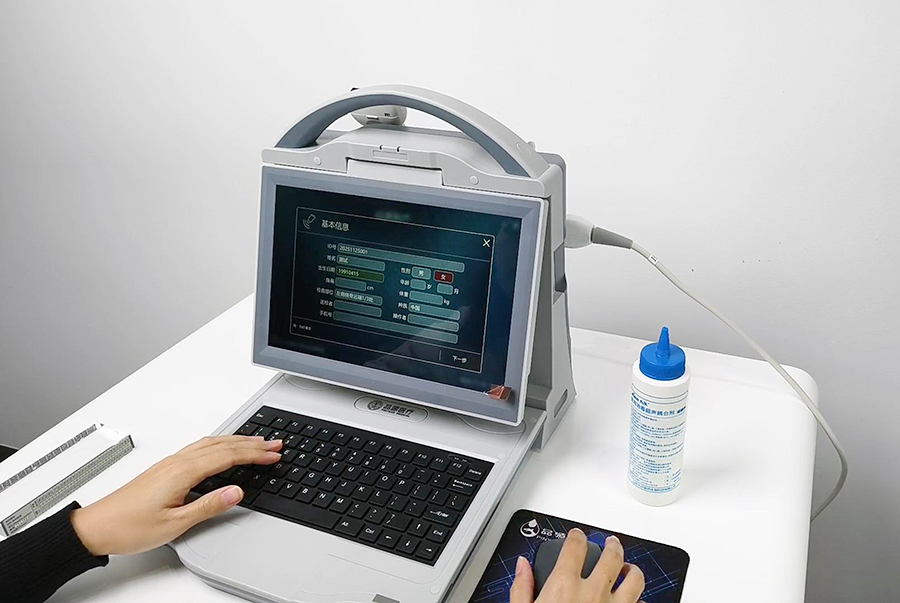
This lowers the technical threshold for operators and minimizes human-induced errors during routine maintenance. Non-radiology staff such as nurses, rehabilitation therapists and physical exam technicians can operate the equipment independently after brief training.
Precise Measurement to Support Clinical Decision-Making
By measuring parameters including Speed of Sound (SOS) of ultrasound propagating through bone tissue, the equipment comprehensively evaluates bone mineral density status and displays results via intuitive numerical values, trend curves and reference ranges.
While quantitative ultrasound bone densitometers are primarily designed for early screening and longitudinal trend monitoring during treatment and cannot fully replace DXA (Dual-Energy X-ray Absorptiometry, the gold standard), their excellent test-retest reproducibility and diagnostic sensitivity allow clinicians to rapidly identify high-risk populations, evaluate intervention efficacy, and provide evidence to determine whether further definitive DXA testing is required.
Tailored for Clinical Screening & Rehabilitation Follow-Up
Screening Phase
During physical check-ups or community health campaigns, the device rapidly identifies individuals with osteopenia or elevated osteoporosis risk, recommending early intervention or confirmatory DXA scans.
Rehabilitation Follow-Up
For osteoporosis patients and post-fracture rehabilitation cases, serial bone density rechecks objectively quantify the efficacy of pharmaceutical, nutritional or exercise-based therapies, enabling dynamic adjustment of clinical management plans.
The quantitative ultrasound bone densitometer is no 'all-in-one miracle device', yet it lowers the barrier to routine bone density assessment through non-invasive, fast, safe and user-friendly design. Its core value lies in enabling more people to monitor their skeletal health without discomfort or radiation concerns.